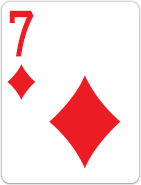
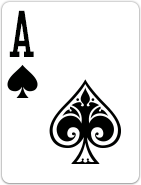
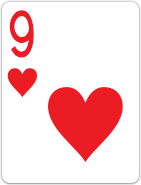
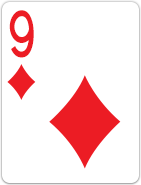
What is Glencoe Solitaire?
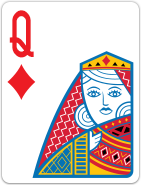
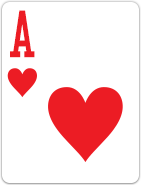
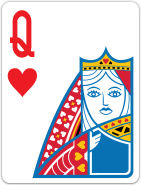
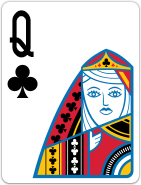
Glencoe is a two-deck patience that takes Intrigue and bolts one extra constraint onto it. As in Intrigue, the eight Queens stay on the table as the immovable heads of eight columns, and the rest of the pack is sorted onto sixteen foundations that run in two opposite directions — down from the Fives and up from the Sixes. The Glencoe difference is where a foundation is allowed to begin: a Five or a Six can only open a pile over a Queen of its own suit.
That single rule reshapes the whole game. In Intrigue any Five could open any free Five-pile; in Glencoe a Five of hearts is useless until a heart Queen is showing with an empty Five slot. Until the right Queen surfaces, a starter card has nowhere to go and must wait in the tableau like an ordinary blocker.
Full rules
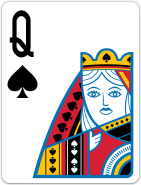
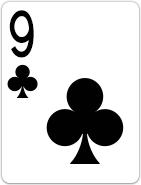
Two standard 52-card decks are combined into a 104-card pack — eight of every rank, which is two of every exact suit-and-rank. The eight Queens (two of each suit) become the bases of eight columns; the first Queen dealt opens column one and each subsequent Queen opens another, up to eight. Each Queen column carries its own pair of foundations: one Five-pile and one Six-pile, both locked to that Queen’s suit.
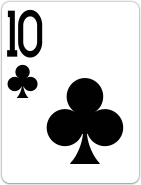
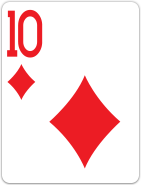
A Five-pile is opened only by a Five of the owning column’s suit, then built downward in the wrap-around order 5 → 4 → 3 → 2 → A → K — and from the Four onward suit no longer matters. A Six-pile is opened only by a Six of the owning column’s suit, then built upward 6 → 7 → 8 → 9 → 10 → J, again ignoring suit after the starter. With two Queens, two Fives and two Sixes of every suit, the arithmetic is exact: each suit’s two Queen columns host that suit’s two Five-piles and two Six-piles. Sixteen foundations of six cards is 96 cards, which with the eight Queen bases accounts for all 104.
During play only the exposed top of a column moves. It can go to a foundation it legally advances, or — the single tableau move — onto a vacant column peeled down to its Queen. You win when all sixteen foundations are complete, which is the same as every column being reduced to just its Queen.
Where the difficulty comes from
Glencoe is harder than Intrigue because the suit lock can strand a starter completely. A Five of spades is dead until one of the two spade Queens is exposed with a free Five slot. If both spade Queens are buried deep in their columns when the spade Fives turn up, those Fives sit in the tableau as blockers — and the Fours, Threes, Twos, Aces and Kings that need an open Five-pile pile up behind them with nowhere to land.
With only eight columns and zero vacancies at the start, your sole maneuvering tool is a column you manage to empty down to its Queen. Because the deck never recycles, a needed Queen or starter buried under the wrong cards can stay pinned for the rest of the game.
Glencoe is part of The Palace · Court games and is a variant of Intrigue.
More Court games games
- Intrigue — Eight Queen columns; eight Five-piles built down to the King and eight Six-piles built up to the Jack, regardless of suit.
- Laggard Lady — Harder Intrigue: a Five or Six can only start a foundation while Queens showing exceed foundations started, so the deal buries more low cards.
- Salic Law — Queens removed; eight King columns and eight A-to-J foundations built regardless of suit, no stock.
Also try
- Babette (Blockade games) — Two-deck blockade with ascending and descending suit foundations.
- Big Ben (Layout, cross & clock-face games) — Clock-face foundations building by suit.
- Miss Milligan (Miss Milligan & row dealers) — Double-deck patience with a weave reserve.
Learn